What does this product-page-to-video-ad demo prove?
It shows the middle layer between a product page and an AI video model: product facts are extracted first, then those facts become hook options, scene beats, proof moments, and a handoff prompt.

Demo
See a fictional product page become extracted ad facts, hook options, storyboard beats, and a model-ready short-form AI video handoff.
Short answer
The useful middle step is separating product, audience, offer, proof, visual context, and CTA details before writing scenes. This demo shows that workflow with fictional LumaSip source copy.
Visual proof
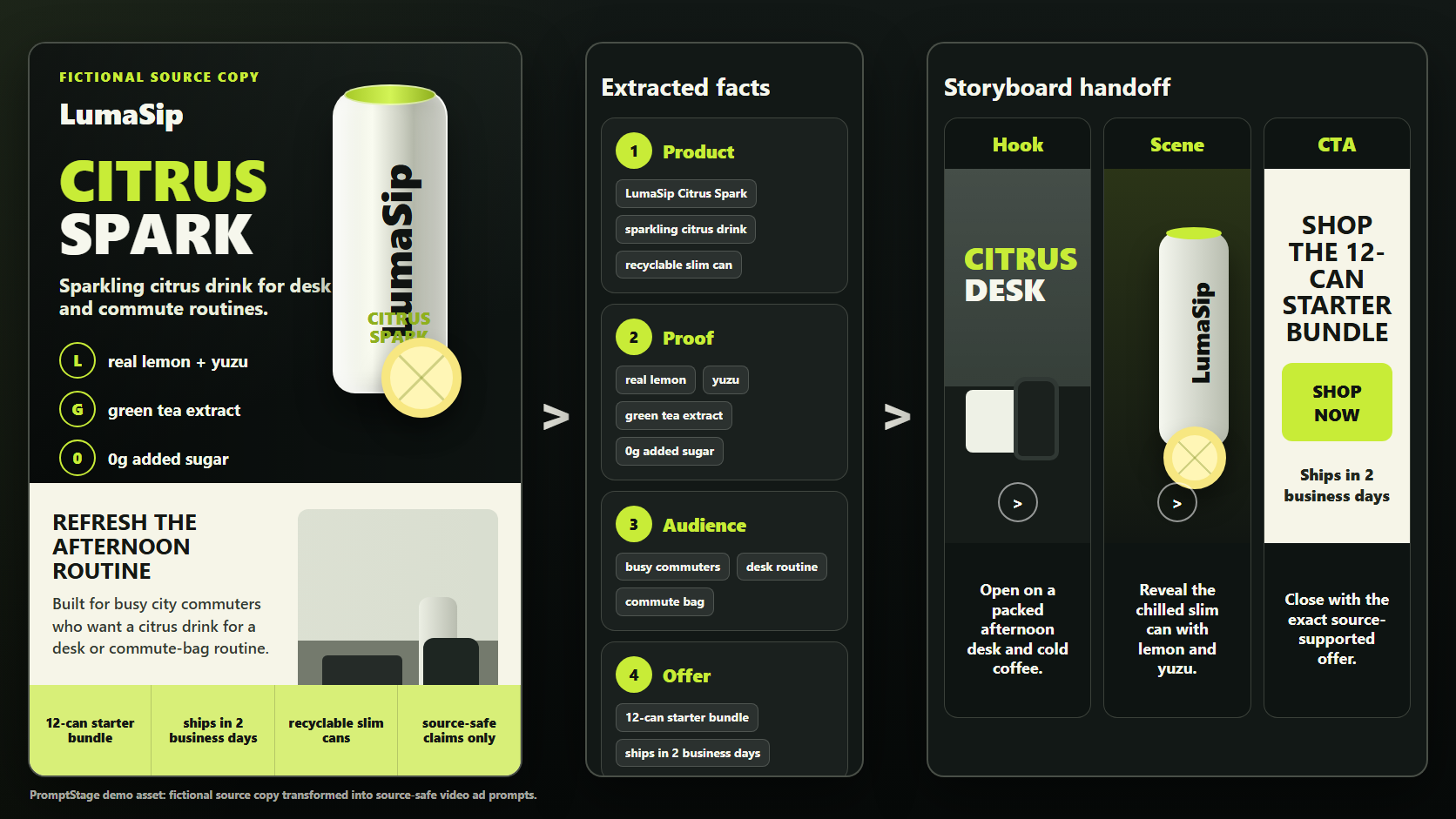
This generated proof asset mirrors the actual Paepae Stack workflow: a product page on the left, extracted ad facts in the middle, and short-form storyboard beats on the right.
Source
Ecommerce product demo
Sparkling citrus drink for busy commuters. Real lemon, yuzu, green tea extract, 0g added sugar, recyclable slim cans, 12-can starter bundle, ships in 2 business days.
Extraction
This prevents the final prompt from becoming a vague product summary. Each extracted fact has a job in the ad.
A sparkling citrus drink in recyclable slim cans.
Busy commuters who want a citrus drink for a desk or commute routine.
12-can starter bundle that ships in 2 business days.
Real lemon, yuzu, green tea extract, 0g added sugar, and recyclable slim cans.
| Page signal | Staged fact | Why it matters |
|---|---|---|
| Sparkling citrus drink for busy commuters. | A sparkling citrus drink for busy commuters. | The buyer and product promise become explicit enough to shape the hook. |
| Real lemon, yuzu, green tea extract, 0g added sugar. | Real lemon, yuzu, green tea extract, 0g added sugar, and recyclable slim cans. | The proof points become visible product and support-text moments. |
| 12-can starter bundle, ships in 2 business days. | 12-can starter bundle that ships in 2 business days. | The offer becomes a closing CTA instead of a buried page detail. |
Output
Your afternoon drink should fit the commute, not fight it.
Show the citrus desk moment before the can becomes the hero.
| Beat | Objective | Prompt direction |
|---|---|---|
| Hook | Show the buyer problem before the product appears. | Afternoon desk shot: packed calendar, laptop, cold coffee nearby, and a commuter bag half open. |
| Product reveal | Make the can and citrus identity readable. | Close on the recyclable slim can with condensation, lemon and yuzu beside it, crisp tab opening. |
| Proof | Connect the visual product to the promise. | Show real lemon, yuzu, green tea extract, 0g added sugar, and recyclable slim cans as restrained support text while the can stays centered. |
| CTA | Turn the product demo into a simple buying action. | Resolve on the 12-can starter bundle with the exact support text ships in 2 business days. |
Create a 30s TikTok product-demo ad for busy commuters. Feature LumaSip Citrus Spark as a sparkling citrus drink in recyclable slim cans, show the citrus desk moment, include only source-supported proof details, and close on the 12-can starter bundle with the exact note ships in 2 business days.
Use it
Paste page copy or fetch a public URL, review the extracted facts, then generate the full ad prompt pack before spending credits in a video model.
FAQ
It shows the middle layer between a product page and an AI video model: product facts are extracted first, then those facts become hook options, scene beats, proof moments, and a handoff prompt.
Yes. Replace the source copy with your product page, check the extracted product, audience, offer, proof, brand, and visual facts, then generate the ad prompt pack from those staged facts.
A demo makes the transformation inspectable before a user pastes their own page. It helps buyers understand what Paepae Stack preserves and what it turns into scenes.