Affiliate disclosure: Some recommended tool links may earn Paepae Stack a commission if you buy through them. Recommendations are based on fit, tradeoffs, evidence, and source notes. Read the disclosure.
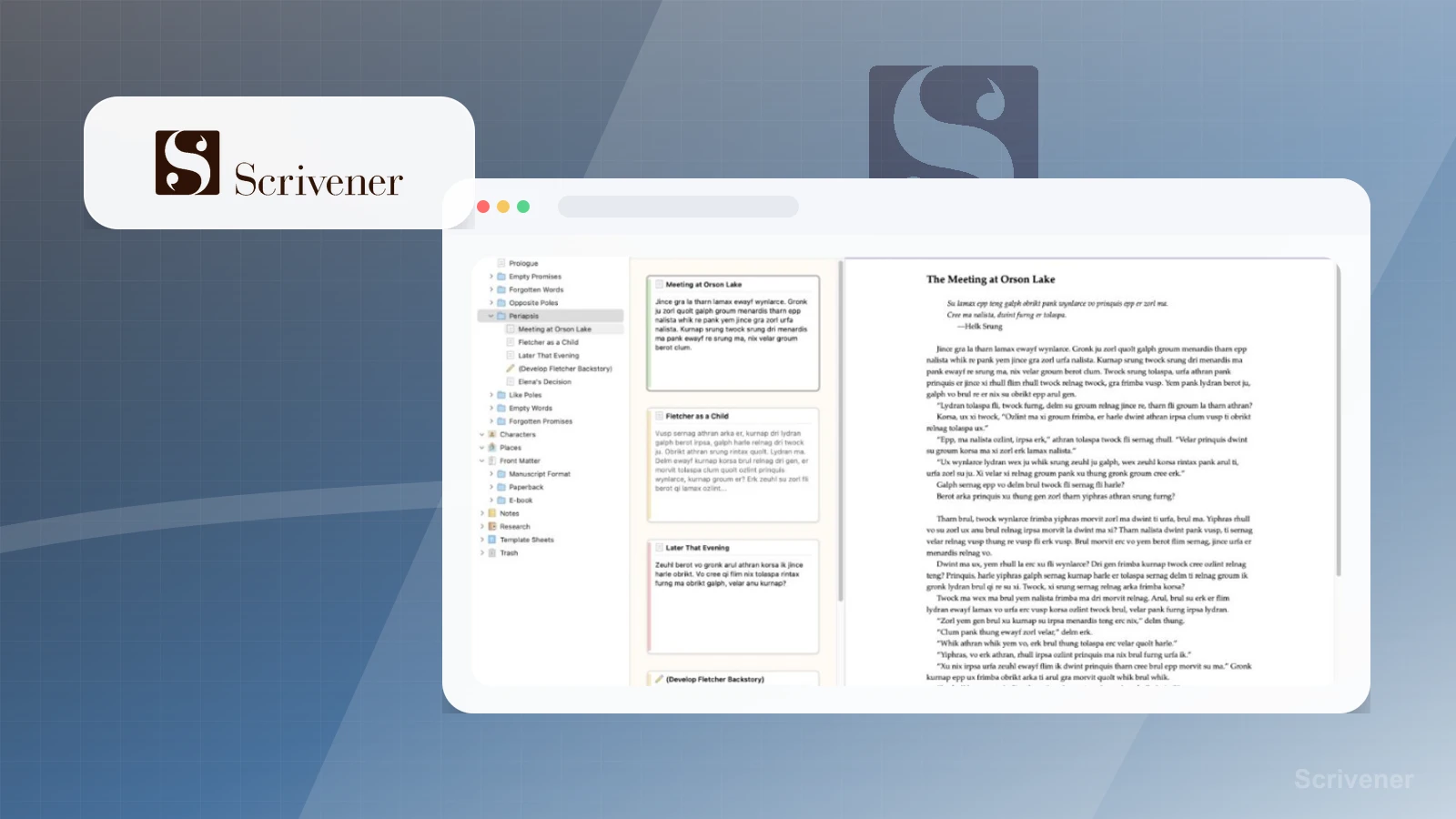
Scrivener product media preview

Workflow evidence

What the Scrivener manuscript workflow looks like

These three PaepaeStack owner-captured Scrivener screens show binder, editor, outline, page, and corkboard interface structure at capture time. They document visible writing-workspace surfaces only, not proof of ownership, authorship, originality, rights, saving, synchronization, backup, compilation, export, publication, writing quality, or outcomes.

Manuscript view

Inspect binder, notes, and editor structure

The manuscript-view capture shows a binder or navigation tree, notes or synopsis cards, and an editor pane with capture-time sample content.

Practical use

  • Map the relationship between navigation, notes, and the editor pane without treating visible sample prose as Aaron's manuscript.
  • Define ownership, authorship, rights, saving, backup, and version-recovery checks separately from the interface structure.

What this screen does not prove: Visible binder items, notes, sample content, and editor controls do not prove ownership, authorship, originality, rights clearance, permission, saving, synchronization, backup, version recovery, writing quality, completeness, or publication.

Scrivener binder, notes, and editor structureOwner-captured Scrivener manuscript-view interface at capture time.

Outline view

Review outline rows and the editor pane

The outline-view capture shows an outline or list pane with section rows and status markers beside an editor pane.

Practical use

  • Identify the visible outline-row, status-marker, and editor-pane relationship before checking structural quality or completeness.
  • Keep outline accuracy, synchronization, formatting, compilation, and export checks independent from capture-time rows and labels.

What this screen does not prove: Visible outline rows, status markers, and editor content do not prove outline accuracy, structural quality, completeness, authorship, saving, synchronization, formatting, compilation, export, publication, or reader response.

Scrivener outline rows and editor paneOwner-captured Scrivener outline-view interface at capture time.

Corkboard view

Inspect page layout and corkboard notes

The corkboard-view capture shows document pages, a writing workspace, an image or table area, and corkboard or inspector notes with capture-time sample content.

Practical use

  • Inspect the visible page, corkboard, and note layout without quoting or summarizing the sample manuscript text.
  • Separate formatting, print readiness, compilation, export, collaboration, and platform checks from the captured workspace.

What this screen does not prove: Visible pages, sample manuscript content, images, tables, corkboard notes, and inspector controls do not prove authorship, originality, rights clearance, writing quality, formatting, print readiness, compilation, export, publication, collaboration, cloud reliability, or outcomes.

Scrivener page layout and corkboard notesOwner-captured Scrivener corkboard-view interface at capture time.

Plain verdict

Should you use Scrivener?

Example to explore for authors who need manuscript structure and drafting control before formatting, publishing, or launch tools.

Use this if

  • Long-form authors
  • Research-heavy manuscripts
  • Book drafting workflows

Avoid for now if

  • Authors who only need final formatting or cover design
  • Low-content workflows where drafting is not the main task
  • Writers who want a simple linear editor with minimal project structure

Evidence status

Documentation-based with workflow documentation

Last verified: 2026-06-02

Outbound status

Approved affiliate link

Affiliate links are disclosed before product clicks. Review the methodology.

Decision flow

Place Scrivener in the stack decision

Use this path before treating Scrivener as the answer. The product should fit the workflow role, comparison fork, and upgrade timing before an outbound click.

Short answer

Scrivener is an under-review candidate for long-form authors when that workflow is already the next bottleneck. Paepae Stack treats this page as documentation-based fit guidance, so it does not prove performance, conversion lift, deliverability, support quality, billing reliability, uptime, or long-term workflow results.

Quick take

A long-form writing and project organization app for manuscripts, research, outlines, drafts, and book-length work.

This is an example to explore while Paepae Stack reviews the workflow. Treat it as documentation-based fit guidance, not as proof of output quality, ad performance, support, billing, or long-term reliability.

Paepae Stack positions Scrivener as author drafting workflow notes, self-publishing planning, and future manuscript-tool comparisons. The fit depends on the workflow, not only the feature list.

The recommendation includes workflow documentation and visible limitation notes, so the page separates what was seen in the workflow from claims that still require stronger proof.

Not ideal for

  • Authors who only need final formatting or cover design
  • Low-content workflows where drafting is not the main task
  • Writers who want a simple linear editor with minimal project structure

Strengths

  • Clear fit for long-form writing and manuscript organization
  • Useful before publishing decisions because it supports drafting and structure
  • Pairs naturally with research, formatting, and launch tools without replacing them

Cautions

  • Keep claims under review until current platform behavior, export, compile, and learning-curve evidence is checked
  • Verify OS compatibility, sync workflow, export formats, and setup friction before recommending broadly
  • Do not treat drafting software as a complete publishing or marketing system

What is still under review

This page is useful for workflow-fit research, but it is not a hands-on proof page yet. The captured interface documents visible controls, while completed owned setup evidence is still needed before making stronger claims.

  • Capture a representative setup path with screenshots or notes that support only the visible workflow claims.
  • Verify current plan limits, billing surfaces, export or migration controls, and cleanup path.
  • Keep performance, support, reliability, deliverability, conversion, or revenue claims out until owned evidence supports them.

Pricing snapshot

Writing software licensing and platform support should be checked by operating system, version, and current store terms.

Start by checking device support, sync workflow, export or compile needs, manuscript organization style, and learning-curve tolerance.

Plan caveats

  • Scrivener is a drafting and organization tool, not a full publishing, formatting, or marketing system.
  • OS compatibility, sync setup, project backups, compile/export behavior, and learning curve should be checked before recommending it.

Pricing sources

Implementation notes

  • Start by deciding the job Scrivener must do in the stack, then compare it against the nearest alternatives.

When to upgrade

  • Upgrade toward Scrivener when the workflow it supports is already visible in the business.
  • Delay the purchase if the tool would create more setup work than customer-facing value this month.

Questions this page answers

Who is Scrivener a good fit for?
Scrivener is a good fit for long-form authors, research-heavy manuscripts, book drafting workflows when that workflow is already the next practical job in the business.
Who should skip Scrivener?
Skip or delay Scrivener if you identify with authors who only need final formatting or cover design or if the tool would add setup work before creating customer-facing value.

Next best action

Decide whether Scrivener fits

The page is past the quarterly review window and should be refreshed before heavier promotion.

Visit Scrivener: Open the approved outbound path after checking the fit notes and plan caveats.

Use Stack Builder: Use the guided path if the right category or stack is still unclear.

Next steps

Compare or continue