Affiliate disclosure: Some recommended tool links may earn Paepae Stack a commission if you buy through them. Recommendations are based on fit, tradeoffs, evidence, and source notes. Read the disclosure.
Skool product media preview

Workflow evidence

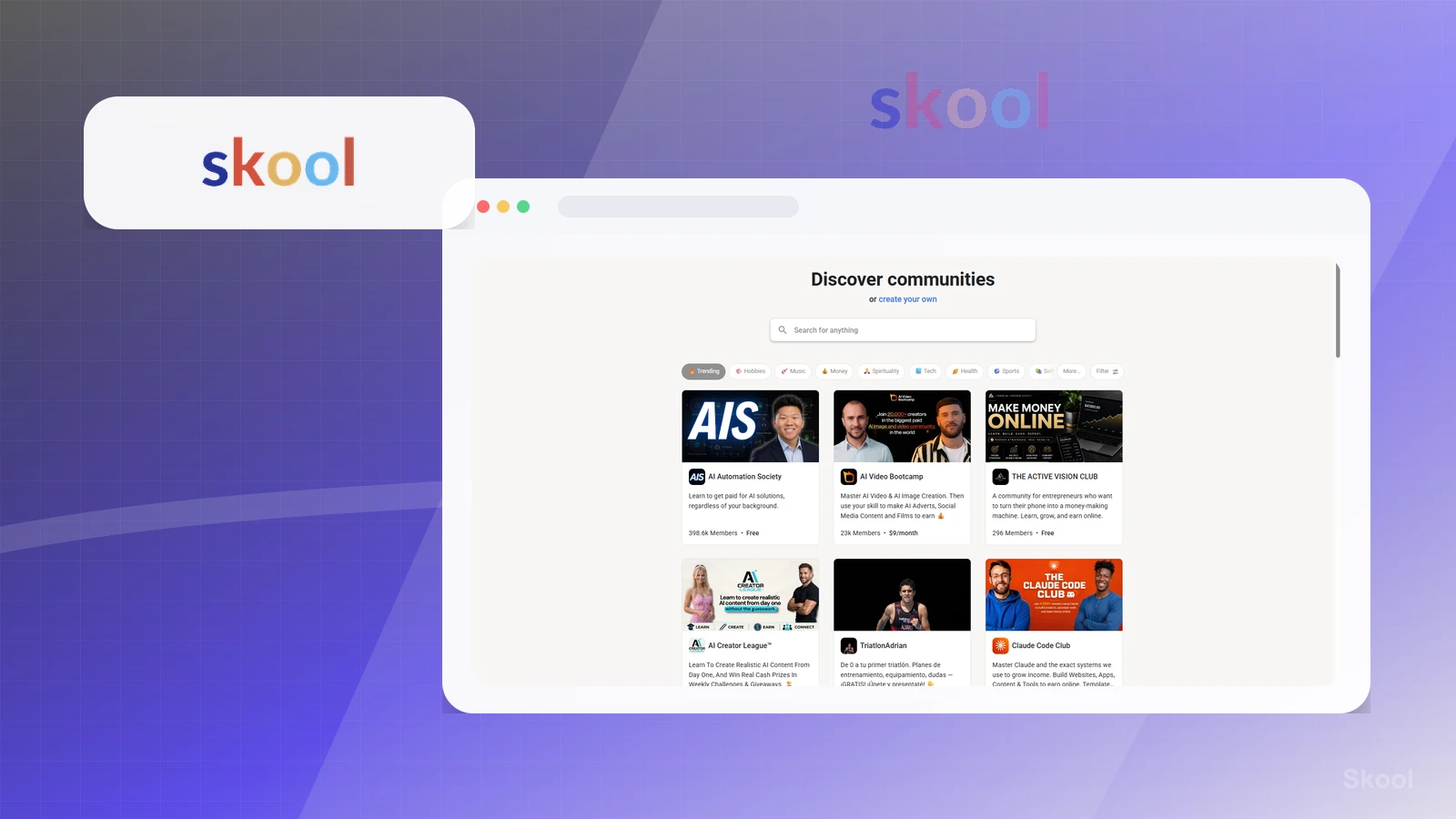
What the Skool community-discovery interface looks like

These three PaepaeStack owner-captured Skool discovery-grid screens document public community-search and card layout at capture time. They are documentation evidence only. The displayed community names, people, prices, member counts, claims, offers, and other card content are third-party capture-time content, not PaepaeStack endorsements, verification, rankings, or outcomes.

Discovery controls

Inspect the discovery search and filter surface

The discovery screen shows a community-search heading, search, create-your-own link, category controls, filter control, and public community-card grid.

Practical use

  • Map the visible discovery controls
  • Compare candidate communities only after independent policy and suitability checks

What this screen does not prove: Discovery controls and public cards do not prove that a community is current, suitable, verified, endorsed, available, or successful.

Skool discovery controlsOwner-captured Skool discovery-grid interface at capture time.

Community cards

Review card fields with displayed prices and counts

The public card grid shows community artwork, names, short descriptions, displayed member counts, and displayed free or monthly price labels.

Practical use

  • Identify the information a discovery card presents
  • Verify membership, pricing, terms, moderation, and fit from current primary sources

What this screen does not prove: Displayed cards, prices, member counts, descriptions, and promotional text do not prove availability, accuracy, quality, participation, revenue, or outcomes.

Skool community cardsOwner-captured Skool public discovery-card grid at capture time.

Discovery results

Inspect additional public discovery results

The discovery grid displays further community-card examples across business, AI, finance, sales, dispatching, advertising, cybersecurity, and other topics.

Practical use

  • Observe the visible range of public discovery-card topics
  • Treat each community as a separate research subject rather than a recommendation

What this screen does not prove: Additional discovery results do not prove a topic's quality, ranking, member authenticity, earnings claim, educational value, payment reliability, or PaepaeStack endorsement.

Skool additional discovery resultsOwner-captured Skool additional discovery-grid interface at capture time.

Plain verdict

Should you use Skool?

Example to explore when the business is selling access to a community or coaching environment, not only delivering static course content.

Use this if

  • Community-led offers
  • Coaching communities
  • Paid membership spaces

Avoid for now if

  • Creators who only need checkout and file delivery
  • Teams that need WordPress-owned access control or deep site customization
  • Anyone expecting a community platform to create engagement without ongoing facilitation

Evidence status

Documentation-based with workflow documentation

Last verified: 2026-06-11

Outbound status

Approved affiliate link

Affiliate links are disclosed before product clicks. Review the methodology.

Decision flow

Place Skool in the stack decision

Use this path before treating Skool as the answer. The product should fit the workflow role, comparison fork, and upgrade timing before an outbound click.

Short answer

Skool is an under-review candidate for community-led offers when that workflow is already the next bottleneck. Paepae Stack treats this page as documentation-based fit guidance, so it does not prove performance, conversion lift, deliverability, support quality, billing reliability, uptime, or long-term workflow results.

Quick take

A community, coaching, course, and membership platform for creators who want a paid or free member space around learning and group participation.

This is an example to explore while Paepae Stack reviews the workflow. Treat it as documentation-based fit guidance, not as proof of output quality, ad performance, support, billing, or long-term reliability.

Paepae Stack positions Skool as community-platform planning, coaching/community fit checks, and future membership-stack comparisons. The fit depends on the workflow, not only the feature list.

The recommendation includes workflow documentation and visible limitation notes, so the page separates what was seen in the workflow from claims that still require stronger proof.

Not ideal for

  • Creators who only need checkout and file delivery
  • Teams that need WordPress-owned access control or deep site customization
  • Anyone expecting a community platform to create engagement without ongoing facilitation

Strengths

  • Clear fit for communities, coaching groups, and member interaction
  • Simple platform story for creators who want community and learning in one place
  • Useful comparison point against broader community and WordPress membership tools

Cautions

  • Keep claims under review until community setup, payments, moderation, member export, and migration evidence is documented
  • Verify current pricing, group rules, course behavior, payment flow, exports, and admin controls before recommending broadly
  • Do not imply member engagement, retention, revenue, learning outcomes, or community growth without evidence

What is still under review

This page is useful for workflow-fit research, but it is not a hands-on proof page yet. The captured interface documents visible controls, while completed owned setup evidence is still needed before making stronger claims.

  • Capture a representative setup path with screenshots or notes that support only the visible workflow claims.
  • Verify current plan limits, billing surfaces, export or migration controls, and cleanup path.
  • Keep performance, support, reliability, deliverability, conversion, or revenue claims out until owned evidence supports them.

Pricing snapshot

Community and membership platform pricing should be checked against current group, payment, course, member, and admin needs.

Start by checking whether the offer needs a free community, paid community, coaching group, course space, payments, moderation, and member export or migration options.

Plan caveats

  • A community platform creates an ongoing facilitation job; software does not prove engagement, retention, or revenue.
  • Check current pricing, payment behavior, group limits, admin controls, exports, and cancellation terms before recommending it for a real audience.

Pricing sources

Implementation notes

  • Start by deciding the job Skool must do in the stack, then compare it against the nearest alternatives.

When to upgrade

  • Upgrade toward Skool when the workflow it supports is already visible in the business.
  • Delay the purchase if the tool would create more setup work than customer-facing value this month.

Questions this page answers

Who is Skool a good fit for?
Skool is a good fit for community-led offers, coaching communities, paid membership spaces when that workflow is already the next practical job in the business.
Who should skip Skool?
Skip or delay Skool if you identify with creators who only need checkout and file delivery or if the tool would add setup work before creating customer-facing value.

Next best action

Decide whether Skool fits

The page is past the quarterly review window and should be refreshed before heavier promotion.

Visit Skool: Open the approved outbound path after checking the fit notes and plan caveats.

Use Stack Builder: Use the guided path if the right category or stack is still unclear.

Next steps

Compare or continue